

Haruyuki Nagi, Japanese cuisine expert specializing in food education
Food sustains life, and people can rise again and again.
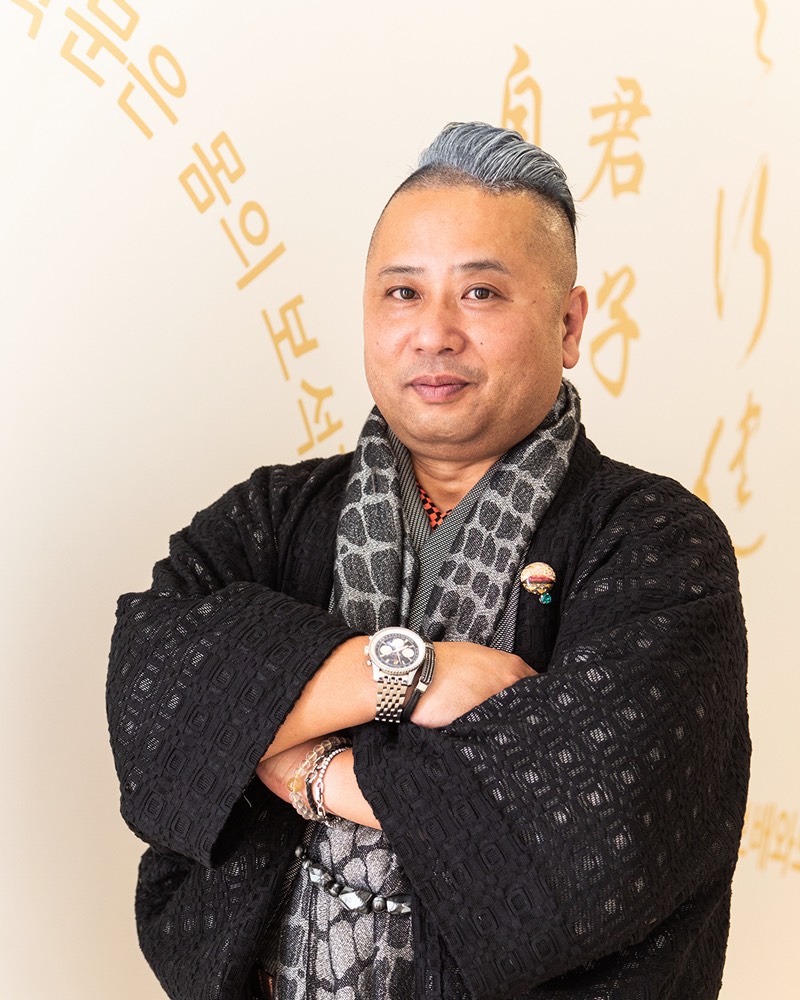
Food education and Japanese cuisine expert, Shunko Nagi
■ Profile
A Japanese cuisine expert and food education specialist. Born in Makurazaki City, Kagoshima Prefecture. After graduating from Tsuji Culinary Institute, he trained at a long-established restaurant in Kyoto and served as head chef at hotels and kappo restaurants. After returning to his hometown, he established Juraku Co., Ltd., and is engaged in food education lectures, cooking classes, product development, and regional revitalization. He also gives lectures and demonstrations of Japanese cuisine in France. His book is "Japanese Cooking Classes That Are Hugely Popular in France." His motto is "To bring smiles to the world with Japanese food culture."
Haruyuki Nagi, a Japanese cuisine educator specializing in food education, has dedicated 39 years to Japanese cuisine. He gives approximately 300 lectures a year. However, behind this success lies a tumultuous past during his apprenticeship and numerous difficulties, including the bankruptcy of his business. Currently, he works under the theme of "bringing smiles to the world through Japanese food culture." In this interview, we spoke with Haruyuki Nagi about his experiences and the crises and challenges facing food culture.
I think I was quite a troublemaker during my school days. By "troublemaker," I mean something like getting into a fight to help someone who was being mugged, but it went too far and I dropped out of high school soon after. I hadn't studied much, so I thought I had no choice but to learn a trade, and that's how I entered the world of cooking. I was allowed to live at a restaurant while attending culinary school, so I would do the restaurant's purchasing in the mornings, go to school during the day, and then come back and help out at the restaurant until late at night. While learning all kinds of cuisine at culinary school, I felt that Japanese cuisine was the most delicious, so I decided to pursue a career in Japanese cuisine. There were about 2500 people in my class at culinary school, but I was one of the top students and a model student, so I was able to get a job at a popular restaurant in Arashiyama, Kyoto. But from there, it was full of obstacles. The dormitory was a prefabricated building with a hole in the roof, and when it snowed, it would pile up in my face. When I went to work and said "Good morning," I would be told "Your voice is too quiet" and get hit. The next day, when I entered with a loud voice, I was told, "Your voice is too loud," and was beaten up. All 30 of my classmates ran away in the middle of the night, and in the end, only about two of us remained. At first, I was only given menial tasks and wasn't allowed to cook, so I wondered when I would be able to become a chef. I secretly went into the kitchen and scaled fish, but of course, my seniors found out and beat me up. Still, I continued for a week. After being beaten for a week, my face was so swollen that it no longer looked like a human face. Seeing that, my seniors must have gotten scared, because they told me, "You can enter the kitchen from tomorrow," and I was allowed into the kitchen relatively soon, and I became head chef at the age of 28.
■The food crisis hitting Japan
After the war, Japan's food environment changed dramatically. In exchange for convenience, our daily lives are filled with foods laden with additives and preservatives. While the number of lonely deaths is increasing today, whereas in the past neighbors would have noticed something was wrong due to a foul odor, recently there has been an increase in "bodies that don't smell even after dying alone." This is because people regularly eat convenience store meals and other similar foods, and their bodies become saturated with preservatives. In an experiment where mice were given the same amount of preservatives as those found in convenience store meals, they died instantly. The body cannot digest these chemical substances, and in men they accumulate in the liver, while in women they accumulate in the uterus. However, the power of nature is tremendous. By cutting out chemical seasonings and consuming pesticide-free organic vegetables and vibrant "seasonal vegetables," the body's natural "self-healing power" will work to eliminate toxins. A 7-year-old child can reset in a week. Even adults can reset in six months. Furthermore, the situation in Japanese agriculture is serious. The real reason why the number of farmers is decreasing is not simply a "labor shortage." There's a sad reality that "no matter how hard they work, the income is so low that parents don't want their children to take over the farm." If this continues, in 30 years there will be no farmers left in Japan, and we'll have no choice but to rely on overseas for food. That's why I keep saying in my lectures, "When you shop at the supermarket, please choose domestically produced or locally grown vegetables, even if only a little." By consumers buying domestic products, we can protect farmers' incomes and secure the future food tables and lives of our children.
■ Even when you hit rock bottom, keep trying
My smooth-sailing career took a dramatic turn when my mother fell ill. When I decided to return to my hometown of Kagoshima to care for her, those around me gave me cold stares, saying, "Nagi's career is over." Giving up a promising career as an industry executive and leaving Kansai was tantamount to "falling from grace." I used that frustration as motivation to become independent and expand my challenges nationwide and even to the world. My lectures on food education have resonated overseas, and at the age of 53, I showcased a whole sea bream sashimi presentation on the Paris Fashion Week stage. Furthermore, when I proposed developing a bento box using "ash-dried" fish made from "Sakurajima volcanic ash," I was laughed at and told, "There's no way you can do that," but I succeeded in commercializing the product despite being in dire straits and facing the risk of having my electricity and gas cut off. It became a huge hit. However, the COVID-3 pandemic made business difficult, and my misplaced pride prevented me from asking for help, leading me to attempt suicide. While hovering between life and death, I spoke with my tax accountant, who told me, "If you're going to die, let's declare bankruptcy," and I filed for bankruptcy. After that, fans and others formed a group called "The Nagi Support Group" to support me. At that time, my bank account was seized, and I couldn't even buy a can of coffee, but after three months, I finally received some money, bought a can of coffee at a convenience store, and cried while holding it. I never thought I would experience something like this in my life, so I have come to deeply appreciate the things that I take for granted. Because of this experience, I didn't want to have any regrets in this one life I have, so I challenged myself at the age of 56 to become a singer, which was my dream since my student days, and I passed the audition, and my major debut is scheduled for next year. You can achieve your dreams even at 56.
■Message to students
I believe the theme of life is "making people happy." Those who can make others happy are the ones who succeed. Successful people in the world have accumulated many failures. Even if the world calls it a failure, the person themselves doesn't see it as a failure. They learn, "If I do this, this is how I'll fall." There is no success without falling. However, many people in modern times are afraid of falling and don't try. It's a cycle of "falling and learning." It's too early to give up in your 20s or 30s. Don't overthink it, just take action. I want you to cherish the spirit of challenging yourself.
Student Newspaper Online, August 31, 2026, Interview with Hideya Tanaka, 1st year student at Nihon University
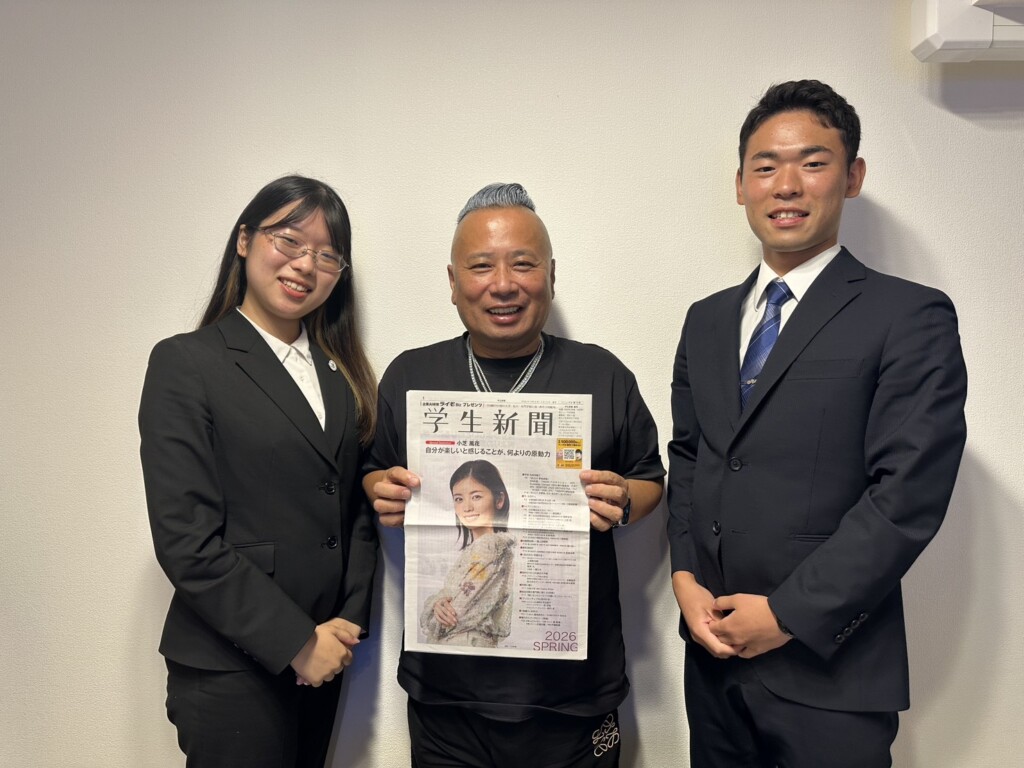
Chiharu Yamada, 2nd year student at the University of Information Management and Innovation / Hideya Tanaka, 1st year student at Nihon University
List of related articles

38th Mynavi Tokyo Girls Collection 2024 SPRIN...

Willgate Co., Ltd./J Frontier Co., Ltd./E...

Takashi Sato, President and CEO of Sukesan Co., Ltd.

Yoshinori Hinata, Mayor of Tsuru City, Yamanashi Prefecture
SWCC Co., Ltd. Representative Director, CEO, President and Executive Officer, Komata...

Nippon Life Insurance Company, Representative Director, President and CEO...

The film "FUJIKO" stars Yuki Katayama / Planning and production...

No comments yet.