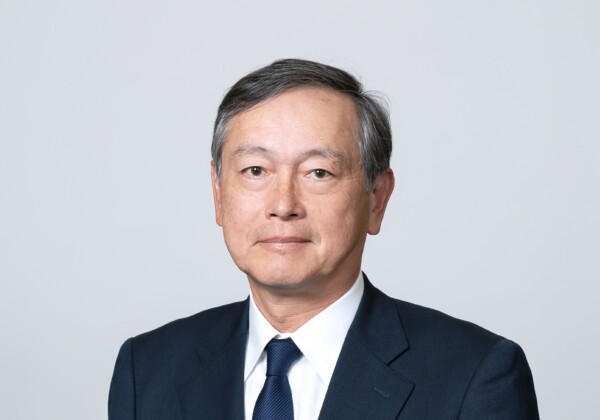
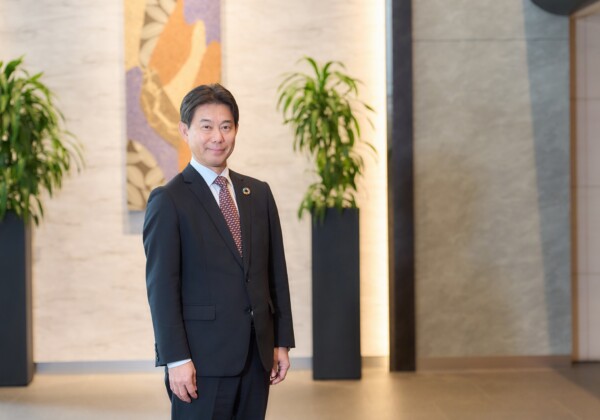
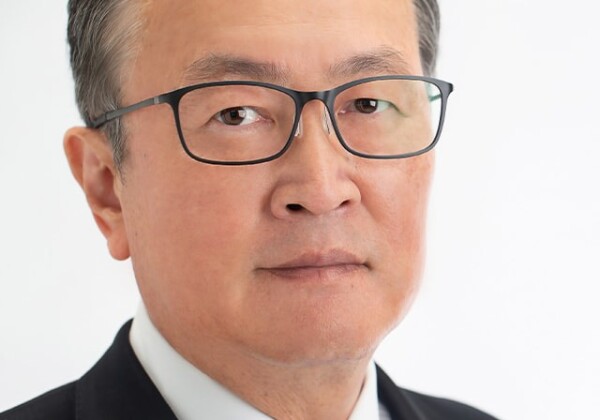
NVIDIA Japan Representative: Masataka Osaki
In a world connected by AI, Japan's strengths become a force for the future - Masataka Osaki, NVIDIA Japan Representative ■Profile Joined Texas Instruments Japan in 1991. After gaining experience as an engineer and in sales in Osaka, he moved to the US headquarters. He was in charge of business development and worked on a wide range of products for over 20 years, while also holding various management positions. Joined NVIDIA in 2014. He has led the expansion of the market and ecosystem and is focused on spreading AI computing in Japan. He holds a Master of Business Administration (MBA) from Tokyo Metropolitan University. NVIDIA is a global leader in accelerated computing. Masataka Osaki, the Japan Representative of NVIDIA, says, "If everything is connected by AI, there is great potential for Japanese manufacturing and services." Reflecting on his diverse experiences from engineering to sales, he called on students who will live in the coming AI era to "be interested in a variety of things and take on challenges without regrets." When I was a student, I wasn't as exemplary a student as you all are. When I was a student, I didn't think much about work, and I didn't study that much either. All I did was work part-time and surf. It was the bubble economy era, and I enjoyed the atmosphere and the time. I chose to major in nuclear engineering at Kinki University because I thought it was cutting edge at the time. I believed that energy would become important in the future. However, I didn't become passionate about it after entering university. The regret of "I should have studied more when I was a student" lingered even after I became a working adult. So, at the age of 40, I enrolled in graduate school at Tokyo Metropolitan University. My first job was at the semiconductor manufacturer Texas Instruments. I was attracted to the party-like atmosphere typical of American companies and the friendly HR staff. After working there for 23 years, I joined NVIDIA in 2014. In my mid-40s, I was thinking, "Am I going to stay at the same company until I'm 60?" when I received an offer from the company. I spoke with CEO Jensen Huang, and being captivated by him was a major factor. You only live once. I didn't want to have any regrets later, so I consulted with my family and took the plunge. ■From Semiconductors to "Systems" Originally, NVIDIA developed GPUs (Graphics Processing Units), semiconductors for graphics in PC games and other applications. However, their superior computing power began to be utilized in the field of scientific and technical computing, and in 2008, NVIDIA's GPUs were adopted for the world's first supercomputer, "TSUBAME," at the Tokyo Institute of Technology. Shortly after I joined the company in 2014, the wave of AI arrived. NVIDIA's technologies, including GPUs, began to be used in various fields such as image recognition, autonomous driving, and medical imaging diagnosis. At that point, NVIDIA made a major shift towards AI, and its Japanese subsidiary expanded rapidly. NVIDIA proposes entire systems that include not only semiconductors such as GPUs, but also software, servers, cooling systems, and storage. A distinctive feature is that we have experts who are well-versed in each industry, such as autonomous driving, drug discovery, medical imaging, and robotics. Rather than selling products, we provide tools for customers to create their own systems, and we have cultivated a developer ecosystem over a long period of time. In Japan, we also collaborate with robotics companies such as FANUC, Yaskawa Electric, and Kawasaki Heavy Industries. We are particularly focusing on "physical AI." It's easiest to understand if you think of AI as the "brain" and robots as the "body." By having AI receive information from sensors, think, and move its body, robots can make autonomous decisions. Autonomous driving is one example of this. ■People who don't confine themselves to their specialization but "enjoy" the world will thrive. What I think is important for people who will succeed in the age of AI is sensitivity to technology. It's about being sensitive to what kinds of industries and innovations are happening not only in Japan but around the world. And it's about having the flexibility to take a bird's-eye view of the whole picture, rather than getting bogged down in just one specialty. AI will connect worlds that were previously separate, such as games, cars, medicine, universities, and startups. People who can find these changes "fun" are strong. I think it's because they find it fun that they can be sensitive to a variety of things. At NVIDIA, we have experts in each field, such as cars, medical imaging, robotics, universities, and supercomputers. Our Japanese subsidiary mainly hires mid-career professionals, recruiting people who are well-versed in their respective industries or who have been deeply involved in technology, design, and development. From now on, I want you to have expertise, but also look beyond that. Because AI will offer a variety of options, human ingenuity in deciding what to combine and what to achieve in the end will be crucial. ■Connecting Japan's strengths to AI to create a new society I don't think that NVIDIA is working for America just because it's an American company. We work for the Japanese people, Japanese industries, and Japan. That is our role as representatives of Japan. When it comes to AI, Japan is lagging behind the United States, China, Europe, India, and others. However, Japan has always had strengths in hardware and service fields, and has a craftsmanship that has been honed over a long period of time. If we combine that with cutting-edge AI and software, we should be able to create AI that is uniquely Japanese in terms of safety and accuracy. In fact, NVIDIA's history also has deep ties to Japan. Sega, a Japanese game manufacturer, was the first to adopt NVIDIA for PC games. In terms of supercomputers, there is "TSUBAME" at the Tokyo Institute of Technology, and various Japanese industries have adopted the technology from an early stage. For this reason, NVIDIA positions Japan as an independent region. ■Message to university students I want you all to take on challenges that you will not regret. When you enter the workforce, you'll face many small decisions, such as "Should I call this client today or not?" Each time, I've considered, "If I don't do this now, will I regret it later?" You'll experience worries and struggles, but overcoming each one will reveal a new perspective. I want you to cherish both small and large decisions and move forward step by step. The world is about to change dramatically. AI will enable us to try things we couldn't do before. That's why I want you to have an adventurous spirit and a desire to try something new. I believe each and every one of you has immense potential. (Interviewed by Kaito Sato, 3rd year, Hosei University; Kenhiko Yamada, 1st year, Hosei University; Chiharu Yamada, 2nd year, Information Management Innovation Professional University; Kaito Sato, 3rd year, Hosei University; Tatsushi Harada, 2nd year, Nihon University; Kyohei Nakazawa, 3rd year, Waseda University)